An iconic Annapurna Circuit journey enhanced with Tilicho Lake and a Thorong La Pass crossing. A complete trek through Nepal’s most diverse Himalayan landscapes


Annapurna Circuit Trek with Tilicho Lake - 16 Days
Duration
16 Days
Trip Grade
Strenuous
Maximum Altitude
5416 M
Group Size
Min 2 Persons
Activities
Trekking
Starts
Kathmandu
Ends
Kathmandu
Best Time
Sept, Oct, Nov, March and May
The Annapurna Circuit Trek with Tilicho Lake – Overview
Stretching across the diverse Himalayan landscape, the Annapurna Circuit Trek with Tilicho (4919) is a renowned adventure route that reaches one of the world's highest lakes. The route extends to both Manaslu and Annapurna Trekking areas, covering Nepal’s one of many wonders from cultural and natural history. Protected under the law of Conservation Areas, the region is home to diverse flora and fauna and ancient civilizations.
Offering a unique Himalayan experience, the trek officially begins in the lower Manaslu Region after a scenic drive along the Trisuli River and through riverbank towns nestled among the valley's indigenous communities. The harmony of the Himalayas aligns with the harmony of the cultures that coexist here. Despite their diverse identities and physical differences, every being in the region has existed for millennia, making the Nepal Himalayas a true wonder. From bustling cities to small, loving towns and quaint yet calming villages in the Himalayas, the Annapurna trail is physically demanding yet enchanting in its own way.
A little heads up, the trail might make you crawl on all four limbs on difficult terrains, but endure it thoroughly, and you will witness not mind-blowing but spiritually bewitching scenery, the very reason for Nepal being a trekker's paradise.
Highlights of the Annapurna Circuit with Tilicho
The foremost feature of the trek is the Himalaya Range and Tilicho Lake, a glacial lake located in the Manang District. The trek is prominently known for its astonishing view of the mountain ranges and geographical features, letting trekkers immerse into the snow valleys and mountains as close as possible. The beauty of the trek lies in the trail and routes that not only lead to the unparalleled destination of the Annapurna but also the trail itself, which passes through small villages, underdeveloped yet practical towns, and gradually shifting vegetation. Every path and step you take is the beauty of the Annapurna Circuit Trek. Imagine you are walking through a dense, dark forest for a few days, and with every step, the plants, grass, trees, and even bugs are also gradually shifting, meaning the trek has different stages of immersive experience. At one point, you’re enjoying the greenery of the hills, and in a few days, you are at the alpine highlands enjoying the sights laid ahead of you, and in a few moments, you’re walking on the very scenery that was only within your eyes.
Now, if you’re wondering, “Are mountains and lakes the only highlights of the whole trek?” Then we strongly recommend reading this thoroughly.
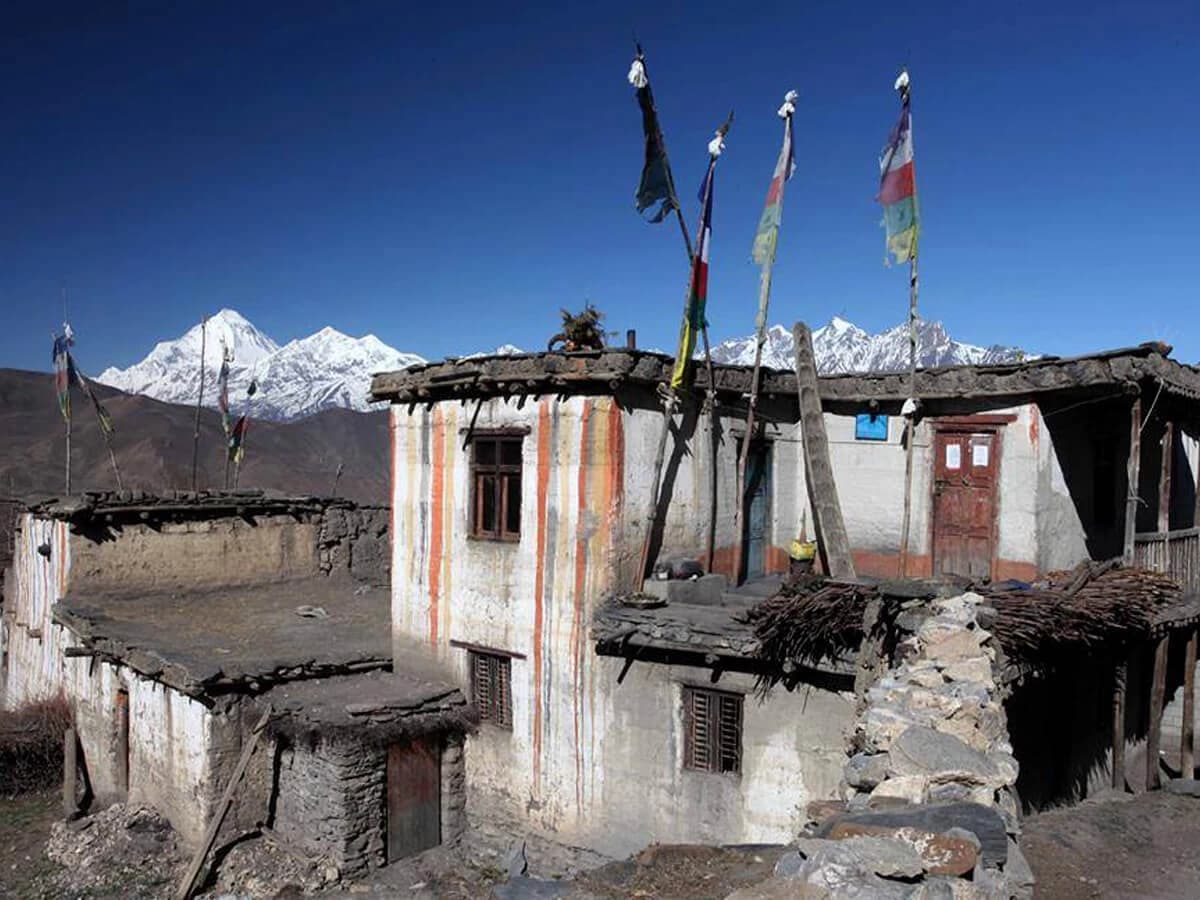
The Annapurna Circuit Trek route is not destination-centered, meaning the circuit trek is also focused on the overall experience of life in the Himalayas. The cultural depth of different ethnicities, their history, and civilization, added to wildlife and all this, carefully knitted with the mesmerizing Himalayas, is the turning point and true highlight of the trek. The small towns in lower Annapurna and Manaslu, stone-housed villages in upper Annapurna, small huts, and people living there with wildlife encounters in the upper region. The trails with Mani walls, prayer flags guiding travelers, and monasteries and temples protecting the centuries-old history, knowledge, and faith of devotees are what make the trek contrasting when compared.
Highlight Breakdown
Ethnicity, Religion & Culture
- Gurung – dominant in lower regions; practice mixed Hindu–Buddhist traditions with a strong community-based culture.
- Magar – present in the lower hills; mainly Hindu, with indigenous rituals and farming lifestyle.
- Brahmin (Bahun) & Chhetri – scattered settlements; follow the Hindu religion with traditional caste-based practices.
- Tamang – found in mid-sections; influenced by Tibetan Buddhism with a distinct language and customs.
- Manangi (Nyeshangba) – dominant in Manang; follows Tibetan Buddhism with trade-based Himalayan culture.
- Tibetan-origin communities – upper regions; strong Buddhist culture with monasteries, prayer flags, and mani walls.
Natural & Cultural Highlights
- Tilicho Lake – one of the world’s highest lakes, a major side trip from Manang.
- Manang Village – a cultural hub with monasteries and an acclimatization stop.
- Thorong La Pass (5,416 m) – the highest point of the trek.
- Muktinath Temple – a sacred pilgrimage site for both Hindus and Buddhists.
- Braga (Braka) Monastery – an ancient monastery above Manang.
- Kagbeni Village – gateway to Upper Mustang with traditional Tibetan culture.
- Marpha Village – famous for apple orchards and Thakali culture.
- Jomsom – administrative and transport hub of Mustang.
- Pisáng & Chame – scenic villages with mountain views and monasteries.
- Kali Gandaki Gorge – one of the deepest gorges in the world.
Flora & Fauna of Annapurna Region
Flora
- Rhododendron Forests (spring bloom in lower hills)
- Pine and oak forests in mid-altitudes
- Juniper and alpine shrubs in higher regions
- Medicinal herbs (Jatamansi, Yarsagumba – seasonal)
- Sparse vegetation and dry alpine terrain in Mustang
Fauna
- Himalayan Thar is commonly seen on rocky slopes
- Blue Sheep (Bharal) in high-altitude regions
- Musk Deer in forested areas
- Snow Leopard (rare, upper Himalayas)
- Himalayan Monal (Danphe) and high-altitude birds
Trekking Annapurna Circuit with Tilicho in 2026
Trekking regions go through constant changes with the growing development of roads in the Himalaya Regions, service upgrades in hotels, and route changes. Although the changes are gradual, with time, such small changes do impact the trekking sectors. So, what is the current condition of Tilicho with the Annapurna Circuit, and is it the right trek for you?
The standard itinerary of the Annapurna Circuit Trek starts with a scenic ride from Kathmandu along the Trisuli River and officially begins from Jagat, a small bustling town in between the Annapurna and Manaslu regions. Now, the road trip may end in Jagat, but road development is currently progressing up to Dharapani; due to unsustainable planning, trekking from Jagat is still in practice. Note that Jeeps are mostly used for land transportation due to unstable roads and their reliability. From Jagat, you trek on and off the road till Bagarchap or Koto, from where you truly enter the remote side of Nepal. Afterwards, the trek is a true wonder that can’t be brought down into words and can only be felt when you’re there.
Our suggestion is to do it if you feel like it. The Annapurna Circuit Trek is still among the top places worth visiting. And with growing development in the service sector, you can actually get quality services even in the remote Himalayas, making the journey more accessible and comfortable. If you’re looking for a week-long journey that can offer you the whole package experience of the natural scenery and cultural depth of multiple ethnicities, then the trek is made for you.
Best season and time to do the Annapurna Circuit with Tilicho
Trekking season in Nepal currently has two practices, or two seasons, which are considered the best times to trek in Nepal, especially for circuit treks that require thorough planning for weather stability. March to May and September to November are globally recognized peak trekking seasons in Nepal. How to know which season to choose from?
Both seasons have their own perks and offer varied experiences that go beyond natural scenery, including cultural events. Year-round, Nepal hosts multiple national festivals celebrated across the country, including the remote Himalayas.
Seasonal Experience Breakdown
Spring Season (March – May)
- Mild to warm daytime temperatures with cool mornings and nights.
- Clear skies in early spring; slight haze toward late May.
- Rhododendron forests bloom across the lower and mid-hills.
- Green terraced fields and flowing rivers in hilly villages.
- Active wildlife sightings, including birds and Himalayan Thar.
- Stable conditions for the Tilicho Lake side trip before the monsoon.
- Major festivals like Holi and Buddha Jayanti are celebrated along the route.
- Lively village atmosphere with both Hindu and Buddhist traditions.
Autumn Season (September – November)
- Stable weather with dry air and excellent visibility.
- Crystal-clear mountain views after monsoon rains.
- Dry trails and safe trekking conditions across the circuit.
- Golden forests and fresh alpine landscapes in higher regions.
- Rivers calm down, reducing landslide risks.
- Ideal season for crossing Thorong La Pass and visiting Tilicho Lake.
- Major festivals like Dashain and Tihar bring vibrant cultural experiences.
- Harvest season adds local life, traditions, and celebrations in villages.
Which season to trek? Trekking is recommended during peak seasons, but the choice of season depends on the trekker's plans. Both seasons give equally rewarding experiences. Choosing the best season comes down to how you want your trip to be. Specific festival choices, trail conditions, and trek technicalities influence the choices.
Annapurna Circuit Trek via Tilicho Lake Outline Itinerary
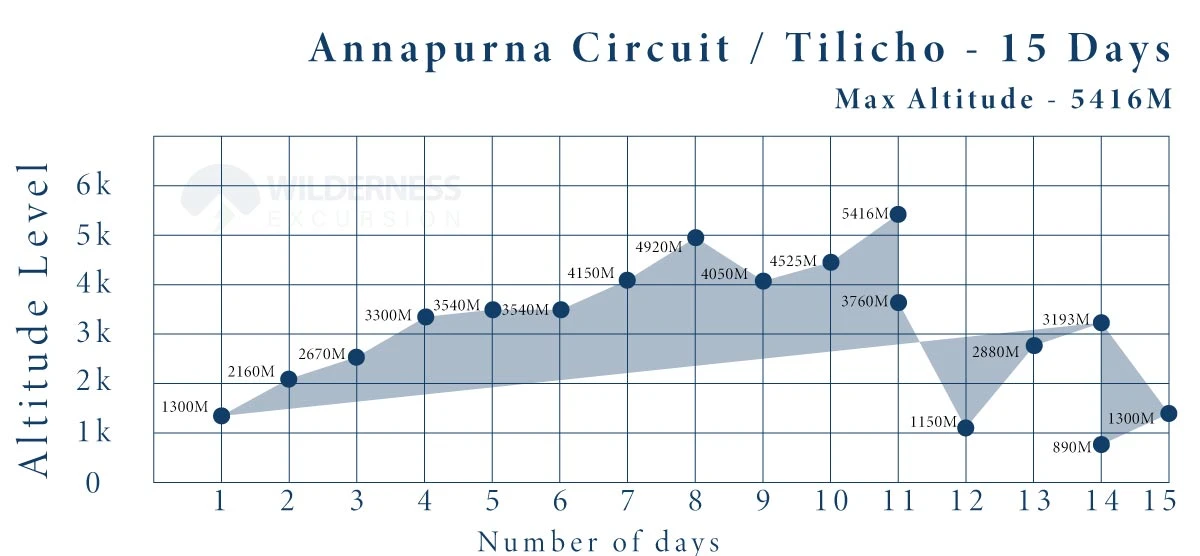
Day 01: Drive from Kathmandu to Besisahar (760 m/2492 ft) to Jagat (1,300 m/4,265 ft)
Day 02: Trek from Jagat (1,300 m / 4,265 ft) to Bagarchhap (2160 m/7085 ft)
Day 03: Trek from Bagarchhap (2160 / 7,085 ft) to Chame (2,610 m / 8,890 ft)
Day 04: Trek from Chame (2,610 m / 8,890 ft) to Upper Pisang (3,300 m / 10,826 ft)
Day 05: Trek from Pisang (3,115m / 10,200ft) to Manang (3,540m / 11,300ft)
Day 06: Take a break day, adaptation day at Manang
Day 07: Trek from Manang (3,540 m/11,300 ft) to Tilicho Base Camp (4,150 m/13,583 ft)
Day 08: Visit Tilicho Lake (4,920 m / 16,138 ft), then back to Tilicho Lake Base Camp.
Day 09: Trek from Base Camp (41 m/13,320 ft) to Yak Kharka (4,060 m/13,020 ft)
Day 10: Trek from Yak Kharka (4,060 m / 13,020 ft) to Thorong Phedi (4,525m / 14,525ft)
Day 11: Trek from Thorong Phedi to Muktinath (3,760 m) via Thorong La Pass (5,416 m)
Day 12: Drive from Muktinath (3,760 m / 12,623ft) via Jomsom to Tatopani (1,200 m / 3,940 ft)
Day 13: Trek from Tatopani (1200 m/ 3,940 ft) to Chitre (2390 mm/7,845 ft)
Day 14: Trek from Chitre (2390m) to Ghorepani (2850 m / 9,385 ft)
Day 15: Early morning hike to Poon Hill (3,210 m), trek to Birethanti (1,039 m), then drive to Pokhara via Nayapul
Day 16: Drive from Pokhara (820 m / 2,690 ft) to Kathmandu (1,350 m / 4,450 ft)
Things to know about the cost and booking advantages for the Annapurna Circuit Trek with Tilicho Lake.
Trekking cost and price variables
The total cost for the trek is determined by its fixed and variable factors. What are these variables?
Any costs incurred due to government subsidies, such as trek permits, municipal fees, and other regular charges imposed by government bodies, can be considered fixed costs. Such costs change only with changes in government regulations and must be paid by both independent trekkers and those traveling through registered agencies. Little notes: those travelling through the agency do not have to worry about obtaining permits or any potential legal fees, as those expenses are already included in the payment for the entire package trip.
Now, what are the variable costs? Any cost with optional choices can be treated as a variable. For instance, services such as transportation, food and beverages, hotel bookings in Kathmandu and Pokhara, and any other personal preferences that result in additional costs are variables. Example: Transportation costs depend on vehicle choice; local buses and shared jeeps can be quite cheap, but booking a private jeep for the trek can be more expensive, and that is a variable cost.
Why mention these costs and their varying factors? These cost factors are vital tools for managing trips and bookings effectively. For independent trekkers, proper research of cost factors is extremely important, as it is for those booking through agencies. Every agency sets a package price within the same range; the only difference is what is included.
Service upgrades and the following cost
The pros of booking through an agency are that you can upgrade your services at any time for an additional fee, and the final payment can be made at the end of the trek. Upgrading your transportation from local travel to a private jeep or car, hotel suite, and flights is available; the included package costs can be upgraded to suit travelers’ preferences.
Cost and Trekking options
There are multiple ways to trek or travel in Nepal: you can be an independent trekker, a private trekker, or a group trekker. And trust us, all of these have their own pros and cons.
Independent Trekking: You plan your trip all by yourself, no guided treks nor any legal bodies responsible for your trip. Everything is done through research and instructions.
Pros:
- Flexible route, no need to follow a mandatory trek route, and can be changed anytime.
- Manageable cost.
- No extra charge for the agency to manage your trip.
Cons:
- Route confusion and possible danger due to lack of knowledge during high passes.
- Permits and municipality fees registration hassle, and unknowingly spend more time and money.
- Rescue operation delays due to the absence of legal bodies in the capital.
Group Booking: Plans are made by a single person with acceptance from the members. Treks are booked through an agency in Kathmandu. More than 10 trekkers in a single group.
Pros:
- Heavy discount with each additional member in the group.
- FOC Policy
- More secure and reliable.
- Affordable cost despite service changes.
Cons:
- Contrast in personal choices and plans.
- Take more time to plan and organize.
- Lack of flexible time and routine.
Private Booking: A family trek consisting of between 2-5 trekkers is a private trek. Trek is booked through a registered agency in Nepal that serves as a legal boy responsible for your whole trip in accordance with the itinerary.
Pros:
- Affordable cost and comfortable trek.
- Secure and guided trek.
- Flexible time and route.
- More perks in services.
Cons:
- A little bit more expensive than group booking.
- Pre-plan and lack of sudden changes in planning.
Service Booking: Every agency provides a package trip which consists of different levels of services, and service booking means using only certain essential services like trek guides and permit arrangements.
Pros:
- Flexible and budget-friendly.
- Secure and guided trek.
Cons:
- Agency fees and guide service fee.
- Trek management during the treks.
- Lodge bookings and cost management.
Wilderness Excursions Free of Cost (FOC) Policy
Our exclusive free-of-cost policy is available in booking options. Especially in group trekking. How does it work?
- 50% off in trekking package for international tour leader if group is 8 to 9pax.
- 100% off in the trekking package for the international tour leader if the group is 10 pax and above.
Why book your next trip with us?
We are a registered trekking agency based in Nepal with decades of experience in organizing both group and private trekking and peak climbing. With 99% successful departure and completion rate, booking with us has its own different perks, such as our FOC Policy.
- We arrange TIMS cards and trekking permits, saving time and confusion.
- Local guides know routes, weather, and culture—reducing the risk of getting lost.
- In case of altitude sickness or injury, we handle rescue and evacuation.
- Accommodation, food stops, and transport are pre-arranged.
- No need to research every detail—you can focus on the experience.
- Agencies plan proper acclimatization days and safe itineraries.
- Our guides help interact with locals, especially in remote areas.
- Some treks require a registered agency to obtain special permits, which we are responsible for obtaining.
- You can trek comfortably without carrying heavy loads with the help of porters.
- Our guides explain traditions, monasteries, and local lifestyles, making the trek richer.
Booking procedure and required documentation
Booking with us is simple and quick. In just a few steps, your next trip will be arranged for the preferred date. Follow the given steps to book your trip with us.
- Click on the ‘Book This Trip”.
- Fill up the required fields in the form and preferred addons.
- Make a 15% advance payment to confirm the booking.
- Enjoy your holiday and stay in Nepal.
What are the documents required for the booking?
With booking and advance payment, you may mail your passport copies with photos for government documentation and processing. We also remind you about the documents when the trip is near the date, after completion of the visa application.
Instant trek departures and booking availability
We also accept instant departures for those who are already in Kathmandu and want to trek as soon as possible. Although a day is required for the government process, arranging a quick departure is also possible. To check booking availability, visit our website.
Itinerary
Expand allPick you up from the hotel in Kathmandu by our guide from Wilderness Excursion and drive to Jagat via Besishahar, marking the start of a journey through diverse landscapes. You will experience a diverse and scenic landscape, valleys, terraced farmlands, exciting suspension bridges, rivers, and quaint villages and explore subtropical forests, the Marshayngdi River, deep gorges, diverse cultures, and landscapes
Our trip now follows the 4 WD road and mule trail and catch an old trekking trail sometime. The trek from Jagat to Bagarchhap winds through the Marsyangdi Valley, offering stunning views. Trails ascend through forests, passing waterfalls and traditional villages. The journey reveals the Annapurna region's diverse beauty. Immerse yourself in the embrace of oak and alpine, as 12km of fresh air fills your lungs
After a good morning breakfast at Bagarchhap, we resume our trek to Chame today. We trek through diverse landscapes, from lush forests, and follow the roaring Marshyandi River, and the Annapurna Circuit unveils its beauty. Winding paths, suspension bridges, and soaring peaks define this Himalayan journey.
We leave Chame today to make our journey to Upper Pisang. Normally people stay overnight in Pisang but we trek to upper Pisang if we can to experience an amazing view of Annapurnas and the great culture and village life in the Himalayas. Today, you will trek a 14 km journey from Chame to Pisang. The route commences at Telukhu Village, where the breathtaking vistas of Pisang Peak and Annapurna II greet you, inviting you to immerse yourself in their majestic beauty. The trek remains engaging throughout, offering thrilling exploration of the steep valley, the Marshyangdi River, and suspension bridges. Traversing the narrow river valley amidst dense pine forests promises an unforgettable experience.
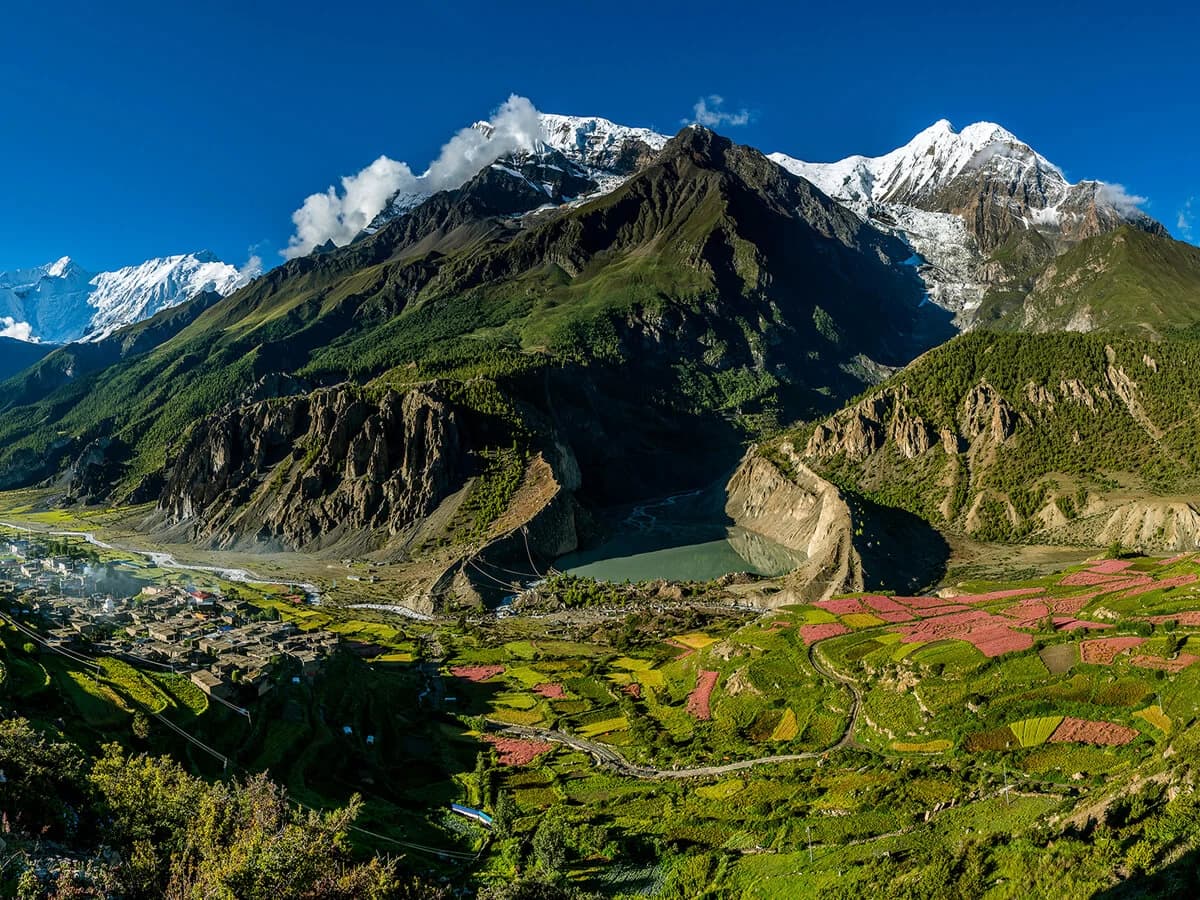
Today’s trek takes you from Pisang to Manang, ascending through the scenic villages of Ghyaru, Ngawal, Munchi, and Braga. As you climb to 3,370m, you’ll experience a thrilling mix of adventure and awe, surrounded by breathtaking natural beauty and ever-changing alpine conditions. Upon completing the 15.5 km journey, settle into a cozy guesthouse for a well-deserved rest. Don’t miss the opportunity to visit the historic Braga Monastery, the largest in the Manang district.
This day is separated as an extra day. This essential rest day allows your body to adjust to the altitude. Spend the day relaxing at your guesthouse or take leisurely walks around the village. Explore local monasteries or visit the serene Gangapurna Lake. For a more active option, embark on a day hike to Milarepa Cave—a 5-6 km (one-way) journey with a round-trip duration of 5-6 hours.
This balanced itinerary ensures a safe and enriching trekking experience in the heart of the Himalayas.
After a good rest day at Manang (3,540m), the trail ascends steadily, passing through Khangsar Village before reaching Shree Kharka. From there, the path becomes steeper, leading to Tilicho Base Camp (4,140m), where trekkers acclimatize before continuing to Tilicho Lake (4,919m). Proper preparation, physical fitness, and altitude awareness are essential for this demanding but unforgettable adventure. Overnight at Tilicho Lake Base Camp.
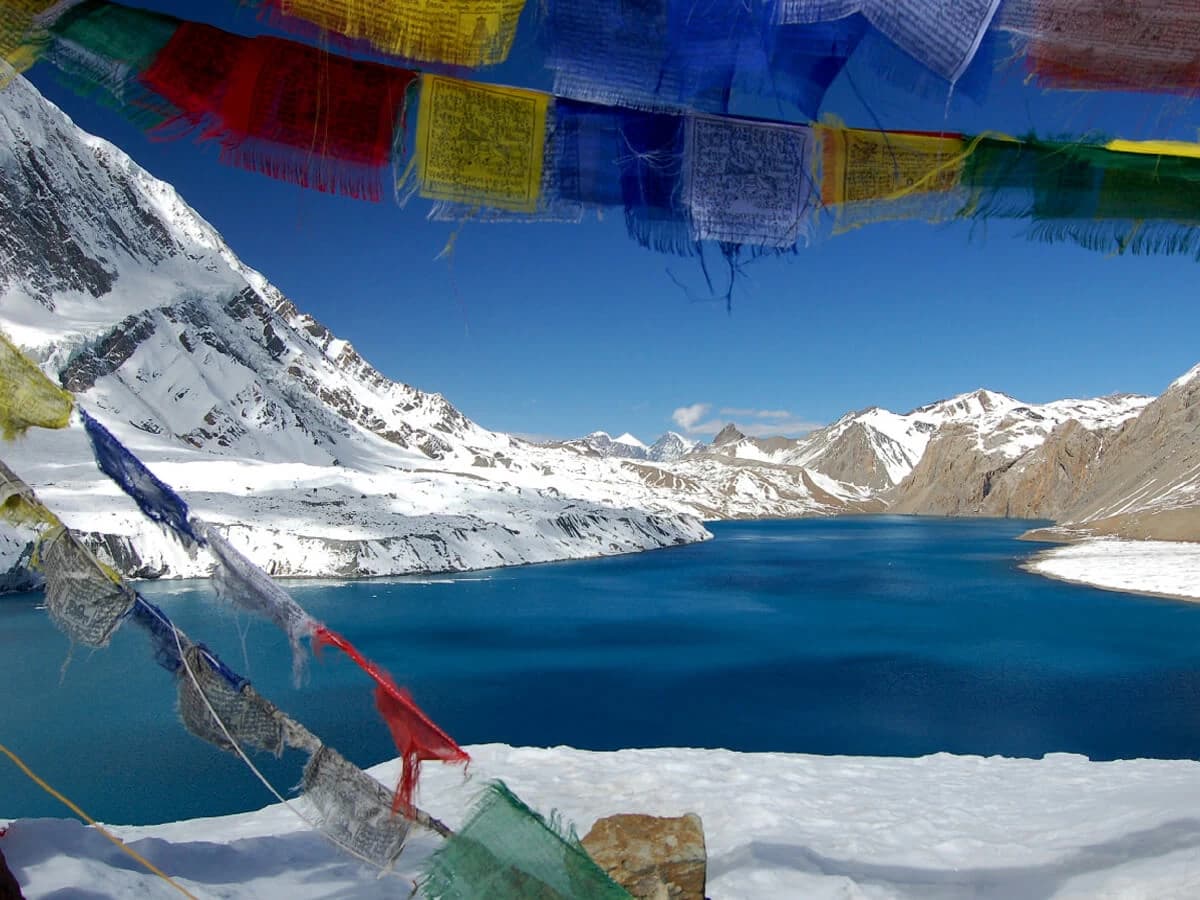
Today, it is a day excursion to hike to Tilicho Lake, once the highest Lake in Nepal at the altitude of 4900 meters above sea level. Enjoy a scenic day trip to Tilicho Lake from Base Camp, trekking through breathtaking landscapes. Witness the stunning turquoise waters of one of the world’s highest lakes, surrounded by majestic Himalayan peaks.
After exploring Tilicho Lake, we trek to Yak Kharka. This scenic route descends slightly through rugged trails, offering stunning mountain views. The 4–5 hour hike passes grazing pastures, with a gradual ascent toward Yak Kharka, a serene stopover for overnight stay. The walk from Tilicho Base Camp to Yak Kharka is approximately 12 kilometers and takes 6 hours approximately.
From Yak Kharka to Thorong Phedi is some 7 Km and the flat trail in the beginning ascends gradually to reach Thorong Phedi. Some people still continue to the high camp from Phedi that help easy cross over Thorong La Pass next day. This part is a steep ascent, it takes another 3 to 4 hours hike to High Camp. Today is undoubtedly challenging as we ascend to 4,450 meters at Thorong Phedi in just four hours, ensuring optimal preparation for the following day. Despite the difficulty, you may be fortunate enough to spot rare wildlife such as blue sheep, snow leopards, or even bearded vultures. Along the way, you might hear mythical tales of legendary creatures like griffons—half-lion, half-bird—believed to roam these majestic landscapes
It is the toughest and longest day today as we cross over the thrilling Thorong La Pass which is 5416 meters (17650 ft). We start early morning at dawn. We climb vigorously along the steep trail that precedes the upcoming rather snowy path. Once we get to Thorang La Pass, a panoramic view of attractive snowy mountains outspreading towards Tibet in the north welcomes you to soak in the divinity of the place and feel a sense of accomplishment, what an auspicious moment to savor the well-deserved reward after a hard-working day. After sharing the happy moment and taking photos we head down to Muktinath; one of the great pilgrimage sites holding religious significance for both Hindus and Buddhists.
After trekking 16 km from Thorong Phedi to Muktinath today, you deserve a restful night at a cozy guesthouse.
The drive from Muktinath to Tatopani covers 110 km of scenic Himalayan landscapes. The route passes through Kagbeni, Marpha, and Ghasa, offering stunning views of the Kali Gandaki Gorge. The journey takes 5–6 hours, with bumpy roads and steep descents. Tatopani’s hot springs provide a relaxing natural hot spa that heals aching muscles from the big adventurous trekking. Overnight in Tatopani. Now, you enjoy the warm weather at a low altitude.
As the adventure gets closer to its end, you may find it tiring so we stop at Chitre overnight, Trekking your way through Ghara and Shikhar villages with typical village sights of children running to school and farmers plowing in the fields and ascending your way. rest and relax in a cozy guest house.
It is a short day to the famous Ghorepani, which is full of trekkers bustling with activities of the Annapurna Circuit trek, and you can savor the beauty of the Annapurna Himalayas: Dhaulagiri, Annapurna, and other peaks from here. An evening hike to Poon Hill is worth to catch a stunning sunset over Annapurna.
A morning hike to Poon Hill is advised from a striking view of f Mt. Dhaulagiri, Annapurna South, Fishtail and others.
Or
Trek down to the ending point. It is our last day of the trek today, .after a nice leisurely breakfast, you take the hiking journey from Ghorepani to Ulleri, concluding your Annapurna Circuit trekking adventure on foot. Then you take a short drive to the lake city of Pokhara. The trip ends, farewell friend!
Our Annapurna Circuit with Tilicho Lake trekking ends today. We wake up in Pokhara, and after breakfast, take a drive back to Kathmandu on a tourist bus. It's 200 km long and initially follows the Marsyangdi River and Trishuli River. Alternatively, you may like to choose a flight to Kathmandu (additional cost of USD 95 per adult) from Pokhara. Now our trek concludes at Kathmandu.
Annapurna Circuit Trek with Tilicho Lake day-to-day itinerary
We have crafted 14 14-night 15-day detail itinerary that starts at Kathmandu followed by a drive from to Jagat and ends walking at Jomsom. Wilderness Excursion suggests you go through the day-to-day program of the trip to learn some guidelines to study about this adventure tour. However, this trekking tour itinerary can be perfectly tailored to your needs. Here, at Wilderness Excursion ensure a high priority for your safe trek with our highly experienced guide for a wonderful trek in Nepal.
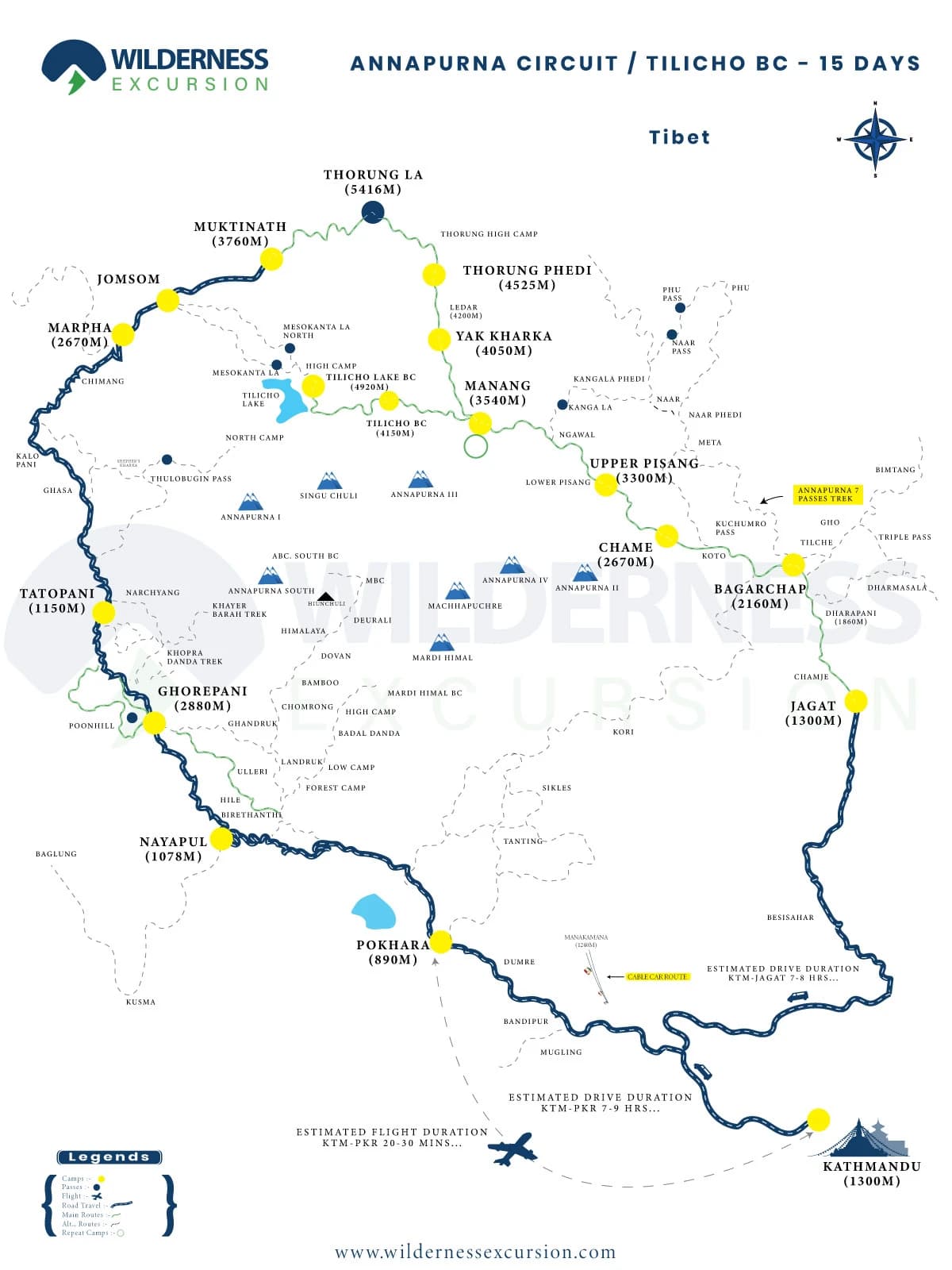
Route Map
Altitude Chart
Still Confuse?
Download brochure or customize your trip.
Cost Details
Includes
- 1 Night deluxe room in Pokhara in hotel mount view or similar (double occupancy basis)
- A knowledgeable native trekking guide who speaks English.
- One high-altitude Sherpa porter to share your main pack with two trekkers.
- During the walk, twin-sharing accommodations are provided in teahouses.
- Meals: 15 breakfasts, 15 lunches, and 14 dinners throughout the hike.
- Public bus transportation to Jagat from Kathmandu.
- Local transportation from the trekking route.
- Tourist coach transportation between Pokhara and Kathmandu.
- The guide and porter fees cover all of their costs.
- Insurance according to the state minimum for your guide and porter.
- Every required trekking permit for the Annapurna Circuit.
- local VAT and taxes.
Excludes
- Meals, lodging, and transportation in Kathmandu.
- Meals in Pokhara except breakfasts.
- Guided touring in Kathmandu, we can arrange if requested.
- Bar and beverages, including Coke, Fanta, and mineral water
- Warm water for the walk and a hot shower.
- Internet, phone calls, and laundry services.
- Personal travel insurance for your trip.
- Rescue operation charge in case of emergency.
- Tips for a porter and guide.
Dates & Availability
Select Departure Dates
Apr 2026
May 2026
Jun 2026
Jul 2026
Aug 2026
Sep 2026
Oct 2026
Nov 2026
Dec 2026
Check our published date! If it doesn’t match, we are happy to customize your tour perfectly to suit your interests and needs. Contact us for creating a unique travel experience for you
Essential Information
Trek difficulty
Trekking difficulty is influenced by varying factors. Each factor plays a crucial role in determining a trek's difficulty. The common method is knowing the trek duration. But some long treks can be easier than a short trek. How? Altitude, acclimatization day, walking duration, personal fitness, and diet plan are also important factors in determining trekking difficulty.
The 16-day Annapurna Circuit Trek with Tilicho Lake reaches a maximum altitude of 5416 m above sea level with a few passes above 4000 m, including Tilicho Base Camp and Lake. Our standard itinerary follows a thoroughly researched protocol for 16 days to ensure good and successful completion. Despite additional rest days and an optimized itinerary, the Annapurna Circuit Trek can pose significant challenges for novices. Below is a difficulty challenge for different age groups and experiences.
- Beginners of all ages: Strenuous and not suggested
- Experienced Trekkers from 16 to 50: Medium Hard
- Experienced Trekkers from 51-69: Medium Hard
- Trekkers above 70: Strenuous and not suggested
How is the trek for children and teens below 16?
For the age group 10-15, the trek might pose significant difficulties if no prior guidance is given. But with proper consultation and guidance, it is actually possible for teens to trek above 5000m. Although some pre-workout or preparation for months before the departure is recommended.
Weather in Annapurna Circuit Trek with Tilicho
The weather in high passes, especially above 4000 meters, is unpredictable. It can be foggy in the morning past 5 and cloudy before 10. Due to such unpredictable weather, circuit treks are strongly recommended during the seasons due to their high value for stable weather and crisp views of the Himalayas. Why is the weather crucial?
Trekking in high passes requires precise timing and favorable weather conditions for the successful ascension of the pass and descent. During ascension, any changes in weather or foggy conditions and heavy snow can hamper navigation and lead to route misadventure. Due to such extreme possibilities, high passes are required to be done early in the morning.
Road structure and Trek trails
Currently, the road reaches Manang from Besisahar and Muktinath from Jomsom, which is 80% of the whole trek. But trails still avoid these road sections to provide an authentic trail experience for trekkers. How?
The route follows alternative trails such as NATT (Natural Annapurna Trekking Trails), which avoids 90% of the road section. These trails go above the road and pass through villages, avoiding dust and vehicles.
Ground transportation and flight to the Annapurna Circuit
Ground transportation, such as a private jeep or a shared jeep, is possible for both ways, to and from the trek. Flight transportation is only possible from the trek (Jomsom to Pokhara). Our package covers the costs of different ground transportation, so any requirement for a flight can also be done with extra charges.
Permits and entry fees
Protected under the laws of the Annapurna Conservation Area Project (ACAP), any trekkers visiting the upper Annapurna Region are legally required to obtain the conservation permit, which costs around NRS 3000 per person each. The upper region of the Annapurna is geographically close to the Nepal-Tibet border; due to such sensitive areas, trekkers are also required to obtain a special permit from the Department of Immigration. Such special permits are to be paid in USD and paid in accordance with the number of stay days in the restricted area. For more information regarding permits and climbing fees, follow the link given: -
- Wilderness Excursion – Nepal Trekking Permit Fees.
- Department of Immigration – special permit fees.
- Nepal Tourism Board – Nepal Trekking and Climbing Fees.
Accommodation and food during the trek
The package price of USD 999 is an inclusive service provided to our valued clients. The package cost covers your daily necessities of food and lodging during the trek. The foods are constantly of similar quantities and qualities throughout the whole trek, except in the places that are near developed towns. So, you can expect a local, authentic cuisine at high altitudes and more food options in towns. During the trekking days, you are provided with a breakfastset with tea or coffee of your choice, a lunch during the day, dinners, and complimentary teas and fruits if possible.
Accommodations are mostly lodges and teahouses on a shared-room basis. The rooms are basic, equipped with a common drawer and two beds. Some places even offer an attached bathroom, which can be arranged when available. Overall, the rooms may seem basic, but they are perfect for a night to relieve the day's stress.
Packing and Preparations for a high-passes trek
Proper packing and preparation are essential for high-altitude trekking, especially during peak seasons when trails are busy but weather conditions can still change rapidly. While spring and autumn offer stable weather, cold temperatures, strong winds, and altitude challenges remain constant in the Himalayas. Smart packing ensures warmth, safety, and comfort, while proper physical and mental preparation helps your body adapt to altitude, reduces fatigue, and prevents health risks like altitude sickness. Together, they create a smoother, safer, and more enjoyable trekking experience.
Packing Tips
- Layered clothing system (base, mid, outer layers)
- Insulated down jacket for cold nights
- Waterproof and windproof jacket and pants
- High-ankle, well-broken trekking boots
- Thermal gloves, woolen hat, and neck buff
- Sleeping bag (–10°C to –15°C rated)
- UV-protection sunglasses and sunscreen
- Reusable water bottles with purification tablets
- Headlamp with extra batteries
- Power bank or portable charging backup
Preparation Tips
- Build cardio stamina through running or hiking
- Strengthen legs for long ascents and descents
- Plan proper acclimatization days in the itinerary.
- Stay hydrated and practice regular water intake
- Learn the symptoms and prevention of altitude sickness
- Test and adjust the gear before the trek
- Maintain a balanced diet before and during the trek.
- Set aside daily personal expenses (USD 10–15)
- Prepare mentally for basic facilities and remote conditions
- Examine weather predictions and make appropriate plans.
- Signs of altitude sickness and precautions
In Nepal, high-altitude trekking entails climbing above 2,500 meters, where oxygen concentrations drop, and altitude sickness risk rises. If appropriate acclimatization and safety measures are not taken, altitude-related problems can arise even during the busiest trekking seasons, such as spring and fall. Serious health risks can be avoided by being aware of the early warning signs of altitude sickness and adhering to fundamental safety procedures. A safe and pleasurable Himalayan experience is ensured by appropriate awareness, gradual ascent, and responsible trekking.
Altitude Sickness Symptoms
- Headache and lightheadedness that persist at higher elevations
- Vomiting, nausea, or appetite loss
- Breathing difficulties even when at rest
- Weakness, exhaustion, and sleep disturbances
- facial or hand swelling, or trouble walking upright
Safety Advice for Trekking at High Altitudes
- Gradually ascend with the appropriate number of days for acclimatization.
- Drink plenty of water and abstain from alcohol and tobacco.
- Walk steadily and refrain from exerting yourself too much.
- If symptoms appear, let your guide know right away.
- Keep emergency travel insurance and basic medications on hand.
Annapurna Circuit Trek with Tilicho Lake - 16 Days FAQs
The Annapurna Circuit Trek through route to Tilicho Lake is located in the Annapurna Conservation Area of Manang and Mustang districts in Nepal, a region in the Himalayas known for its high mountain passes, glaciers, and deep gorges. The lake itself is a high-altitude lake situated in the Manang District, reachable as a detour from the main famous Annapurna Circuit route.
Annapurna Circuit Trek with a side trip to Tilicho Lake is regarded as an adventurous. Trekking at high altitudes, with severe ascents and descents, takes place over extended days. It's advised to have prior hiking experience and a pretty good physical fitness with good stamina to walk 5 to 7 hours a day in mountain trail.
The highest point you will reach is Annapurna Circuit, and Tilicho Lake will be at Thorong La Pass top, which is 5416 meters and 17800 ft high above sea level.
The best time to do this trek is just after the monsoon (Mid September). However usual pleasant weather and spectacular vistas, spring (March–June) or Autumn (September–November) are the best seasons to hike the Annapurna Circuit Trek with Tilicho Lake.
On the other hand, Wilderness Excursion offers year-round Annapurna Circuit Trekking that includes Tilicho Lake.
Wilderness Excursion provides one shared porter between two trekkers, and the maximum weight limit for one porter is 20 kg (10 kg per trekker).
Total days and distance depend on the place you choose to begin the trek and end it. Usually Annapurna Circuit Trek is 12 to 21 Days and approximately 165 to 240 KM
We have currently 2 Annapurna Circuit packages that we operate.
Yes, our guide and porters are insured to ensure their safety and well-being during the trek. And not only for this trek but our field staffs are insured for every trip.
15% of the total value is required to confirm the booking. You can pay via bank transfer, Western Union, or online through the company's website for booking advance, and the rest can be paid in cash, bank transfer, Western Union, or credit card after arrival. We will email you payment details, including available methods.
Yes, we have a refund and cancellation policy. Detailed information is available on our booking terms and conditions on the website.
The best way to avoid altitude sickness is to start your trek at a lower altitude and hike gradually. It helps your body to adapt to the new environment. Hike high and sleep at a lower altitude; stay well hydrated; keep warm yourself; avoid alcohol; and take nutritious food. Our guides will provide further advice
On the Annapurna Circuit, you stay in lodges and teahouses. Each of them is unique and often quite charming.They provide twin beds, including blankets and pillows with basic amenities, and sharing bathroom outside. For warmth, we advise carrying a sleeping bag. Hot showers are available for an extra cost.
Wilderness Excursion does not recommend drinking water from public sources such as rivers, wells, or taps because it could not be potable. Although hotels and shops along the way sell bottled mineral water, we recommend using a water bottle filled with boiled water that can be found at teahouses and hotels for environmental reasons. Many people also fill spring water and use the treatment.
Trekker's are required to bring their own basic medications for the trip. Our guides are professional and well trained but not documented to prescribe medicine. You may consult with your doctor and carry what you need. Basic medicines are available to purchase in Kathmandu. If you have a condition which requires you to bring other then basic medicines, then you may consult with your consultant before the trip and carry the amount you need.
No problem; a vegetarian can have a variety of items on the menu. We make sure that vegetarian clients get adequate nutrient-rich and hygienic vegetarian meals. We select the best lodges and teahouses to guarantee our client's dietary requirements.
Wilderness Excursion does provide pickup and drop-off service to and from Tribhuwan International Airport on request of the client. For that, we require your arrival time in the airport and hotel address.
Yes, renting gear is available and buying even at a cheaper cost. There are several brands in town and many good replicas.
There is WiFi in most of the place, and mobile network (NTC) is available. You can buy a SIM card for 200 NPR and subscribe to DATA with extra cost to stay connected with other parts of the world.
There are daily public buses from main cities like Kathmandu and Pokhara. In this trek, we can also arrange a comfortable private vehicle with extra cost. There are flights available for Jomsom to Pokhara and to Kathmandu from Pokhara
What Our Clients are Saying?
based on 4 reviews
Marvelous adventure Annapurna Circuit with side trip to Tilicho Lake
We completed the Annapurna Circuit trek with Wilderness Excursion, led by our guides Ragul and Luresh, and it was our first major adventure trek in Nepal. The route offers spectacular scenery, including the world’s deepest gorge and the towering Annapurna...
R
Rick H- Denmark
October 30, 2024Annapurna Circuit with Tilicho Lake Trek (12 Days)
We, five Slovakian boys, just completed our Annapurna Circuit Trek via Tilicho Lake side trip in 12 days with Wilderness Excursion and had a great experience. Our fantastic guide, Yuhan Tamang, made sure we were both secure and enjoying ourselves the...
A
Adam Skala- Slovakia
August 24, 2024Extraordinary Journey to Tilicho Lake Trek with Annapurna Circuit
My Unforgettable Trek to Tilicho Lake with Annapurna Circuit
My trip to Nepal was a lifetime experience, and the trek to Tilicho Lake in the Annapurna Circuit stands out as one of the best adventures I’ve ever had. Those five...
D
Daniel Wilson- Canada
October 28, 2022Adventures Tailored for You

Need Help? Call Us+977 9851042153